
Piatt 24-Hour Release Fallback
The Piatt County Sheriff Corrections page gives jail and inmate-information contacts, but it does not provide a current roster, a recent-release archive, or a filter for the prior day. Its statement that the jail operates around the clock describes facility access. It does not mean a public list refreshes every 24 hours. No official Piatt County sheriff inmate app was found either.
Call the Piatt County Jail at (217) 762-3766 first. Ask whether the named person is currently confined. If not, ask whether the last event was release to the community or transfer, and request the receiving agency when a transfer occurred. Staff may limit what they provide by phone. The precise fallback is a request for the existing booking and release sheet or custody-history entry, not a request that staff create a new daily list.
Check Piatt Same-Day Releases
A named-person inquiry works better than searching for a list that does not exist. Keep the full legal name, date of birth if known, case or booking number, and the approximate time range close at hand. Use the following order so each check builds on the one before it.
- Call the jail and ask both present-custody and release-versus-transfer questions. Write down the time of the call and the exact status wording.
- Open the Piatt County case search on Judici. Review the newest order, disposition, sentence, and docket entry for legal context.
- Search the specific person through Illinois VINELink. Check the reporting agency and event, then confirm any alert with the jail.
- If a state commitment appears, use the IDOC Individuals in Custody search after allowing for intake processing. A Piatt departure followed by an IDOC location is a transfer.
- For durable proof, submit a focused Sheriff records request for the discharge or transfer entry and its date and time.
Use the Piatt County released-inmate search when the goal is to trace one person through all custody systems. The Released Last 72 Hours route uses a wider date range and is better after a weekend or when the event time is uncertain.
Piatt 24-Hour Record Fields
Because Piatt County publishes no daily release table, these are the fields to ask for in an existing jail record. They should not be portrayed as columns from a live website. The release disposition is vital because the same departure time can describe either freedom from custody or a handoff.
| Requested field | What it can establish |
|---|---|
| Full name and booking number | Links the event to the correct booking rather than a similar name. |
| Admission and release date/time | Defines whether the recorded exit falls within the exact 24-hour period. |
| Release disposition | Separates court release, time served, dismissal, transfer, or another hold. |
| Releasing authority and case | Connects the physical exit with the court or agency action. |
| Receiving agency | Shows where custody continued when the event was a transfer. |
The jail timestamp is the best county source for the door time. A court order explains the legal basis, but it may not show when the person physically left or whether another hold remained. VINELink is useful for speed, though it is an alert system rather than a certified release record.
Request Piatt Release Records
The county’s Freedom of Information Act page is the official route when a phone call or portal does not settle the question. Address a precise request to the Sheriff FOIA officer. Identify the person, booking or case number if known, and a start and end time. Ask for the existing booking/release sheet, custody log entry, release disposition, and transfer destination. Request electronic delivery when suitable.
Illinois FOIA section 2.15 specifically addresses arrest information, including the date and time a person was released from custody or transferred. The agency generally has five business days to answer a noncommercial request, subject to a permitted extension. The first 50 standard black-and-white pages are free under state law. Some juvenile, medical, safety-sensitive, sealed, or expunged information may be withheld or redacted.
The successful capture of the Piatt County FOIA route shows where a requester can begin.
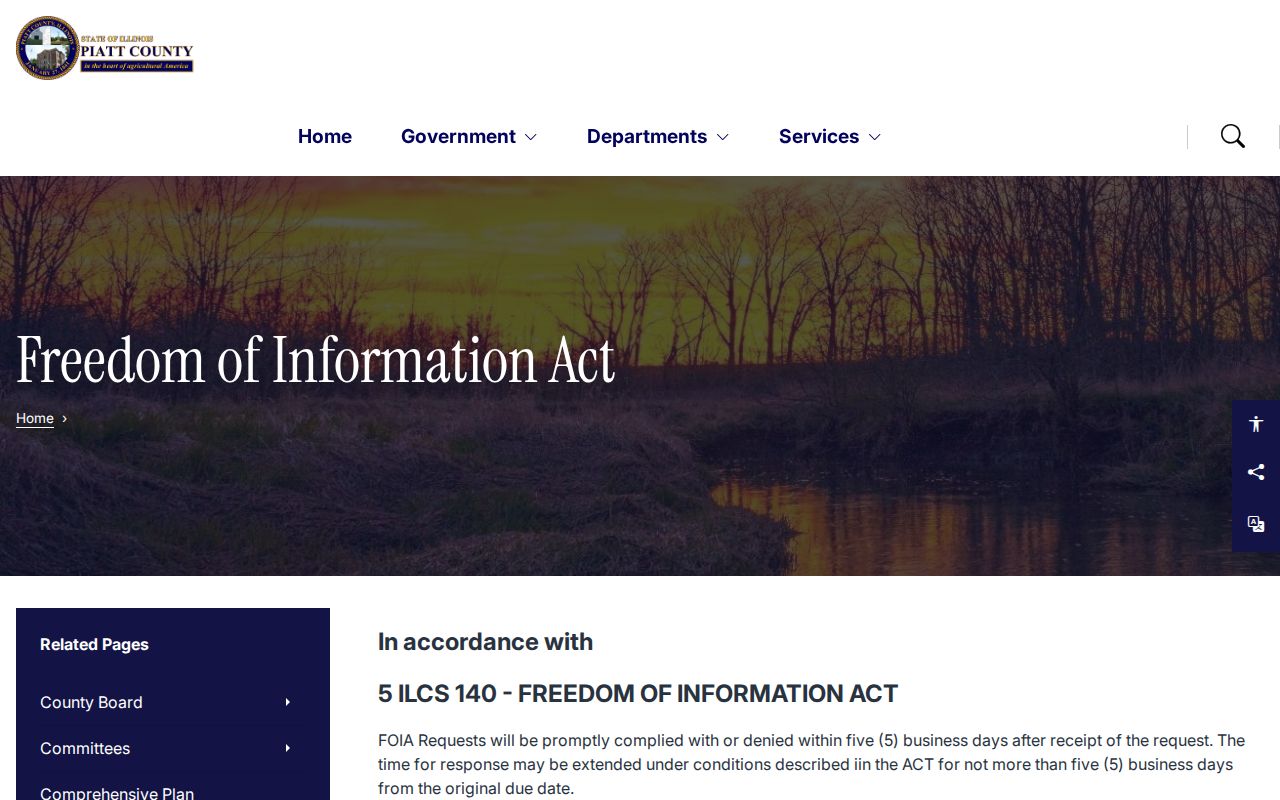
Use that county page to reach the custodian, then describe the existing release record with enough detail to avoid asking for a newly compiled list.
Piatt Release Versus Transfer
“Not at Piatt” has several meanings. A community release ends physical jail confinement, perhaps under a court order or after time served. A transfer also ends Piatt’s physical custody, but the person remains confined by IDOC, another county, the U.S. Marshals Service, or ICE. A detainer is another agency’s claim to custody and can prevent an expected release.
| Finding | Next check |
|---|---|
| Released by court order | Compare the jail exit time with the Piatt court docket and pretrial conditions. |
| Transferred to IDOC | Search IDOC after intake; read status and location together. |
| Transferred to another agency | Ask Piatt for the named recipient, then contact that custodian. |
| No result anywhere | Recheck identifiers and request the county custody event. |
A person on parole or mandatory supervised release has left prison but remains under state supervision. A discharge generally means the sentence and required supervision ended, depending on the system’s wording. Neither term should be inferred from a vanished county record.
Getting Home After Piatt Release
Piattran scheduling information describes demand-response transit with no fixed stops. It asks riders to reserve one business day ahead. Same-day rides may be accepted only when time and vehicle space permit. That makes Piattran a planning option, not an on-demand shuttle waiting at the jail.
A pickup at the Public Safety Building, 1216 Raymond Road in Monticello, must be arranged in advance with the transit provider. The Piattran route information reinforces that trips are scheduled rather than tied to fixed stops. Since no fixed Piatt jail release time or family waiting rule was documented, confirm both the release plan and ride directly before travel.
Piatt Release Payment Instructions
The Sheriff’s published bail instructions still describe in-person processing at any hour. They direct a caller to verify the amount first, bring exact cash or use a listed card, present photo identification, and have the cardholder present. The page states a $40 processing fee plus a card transaction charge.
Current Illinois pretrial release is controlled by the court’s order, so old or generic payment instructions do not establish that money can secure release in a given case. Call before paying or traveling. Piatt County’s Office of Statewide Pretrial Services officer is Kathleen Romer at (217) 341-1516. Pretrial supervision means court-ordered oversight while a case remains pending; it is not proof that the case or a sentence has ended.
No Piatt Daily Release Archive
Piatt publishes jail contact, visiting, commissary, and facility details, yet no distinct 24-hour release URL or archive was found. Web disappearance therefore cannot time an exit. There is also no verified sheriff inmate app supplying release fields or photos. The documented same-day path remains jail confirmation, the Piatt docket, Illinois VINE, and a focused FOIA request.
For a count or chronological set of events, state the exact date and time boundaries and ask for existing records that can be produced in that range. Include release dispositions so transfers are not mislabeled. An agency is generally required to provide held records, not to research an open-ended question or create a custom daily report.
Older county events may remain traceable through the court docket and the Sheriff’s retained records even though no public release archive exists. Search name variants and use the case number when possible. If the event involved a felony commitment, a short delay may occur before IDOC intake appears. Keep the county transfer record because it bridges the gap between the Piatt exit and the state entry.
When the court record and phone response differ, ask whether the docket entry applied to the same booking and whether another hold remained. Record the source and time of each answer. A same-day VINE notice can help identify the agency event, but the Sheriff’s release sheet remains the better source for the exit timestamp. If staff cannot provide it by phone, a narrow electronic request avoids relying on memory or an undated portal result.
Federal paths require the same care. A Piatt-area federal case may involve USMS custody before any BOP record exists. BOP’s locator is for federal prison custody and many historical releases. ICE is separate and should be checked only when a documented handoff supports it. Do not use a missing county name to infer either federal path.